
Are you a student with a bold idea for a more sustainable bioeconomy? Join us and help shape the future of Central and Eastern Europe!
What is the BIOEAST Student Challenge?
The BIOEAST Student Challenge is a dedicated innovation competition for students across the BIOEAST macro-region. It is a unique platform designed to unlock the next generation of bioeconomy thinkers and doers, turning classroom knowledge and fresh perspectives into real solutions for real problems.
How does it work?
The BIOEAST HUBs – national collaborative platforms that gather key bioeconomy stakeholders – have identified key problems and opportunities for a sustainable bioeconomy in Central and Eastern Europe. These have been grouped into eight priority themes.
Students are invited to submit their ideas or early-stage solutions addressing one or more of these themes. Submissions will be evaluated by a panel of experts from the BOOST4BIOEAST project.
Student challenge winners
Indoor lighting objects made from a recyclable, bio-based vitrimer
Our project develops portable smart lighting objects made from an innovative, recyclable, bio-based vitrimer material derived from used cooking oil. By transforming a waste stream into a durable, high-value material, the project aims to reduce reliance on fossil-based plastics and support a more circular use of resources. At the end of the lamp's service life, the lamp's body, which is made of vitrimer, can be mechanically or chemically recycled, while the lamp's wood, metal, and lithium battery elements are designed to be separated where possible for recycling. Adjustable lighting modes, including warm, low-intensity light, support relaxation, sleep hygiene, and everyday well-being. The project demonstrates a practical alternative to conventional plastic-based lighting product
THEME 3: Biowaste reduction and valorization
Treatment of Nitrogen-Rich Waste streams using the methods of Ammonia Stripping, Nitrification, and Thermal Thickening
Our project, developed by an applied research team at the Czech University of Life Sciences Prague (CZU), represents a sustainable, circular technology that transforms nitrogen rich waste streams, specifically digestate, into high-value fertilizers. Our key innovation lies in the direct processing of raw digestate without the need for mechanical separation, effectively recovering ammonia without expensive chemical additives. By integrating ammonia stripping with other biological processes, the system produces commercial ammonium and nitrate fertilizers from the digestate while simultaneously reducing the volume of liquid digestate by 50%.
THEME 3: Biowaste reduction and valorization
- Contact persons: Ing. Jakub Tegel, Ing. Lucie Coufalová
- Email: [czuprague@seznam.cz / coufaloval@af.czu.cz / svehla@af.czu.cz]
- LinkedIn: https://www.linkedin.com/in/ing-jakub-tegel-037208306
- Website: https://katedry.czu.cz/kavr/uvod
TerraWatch/ AI agents that transform free satellite and open data into actionable monitoring for farms and forests, while building harmonized data across the BIOEAST macro-region.
TerraWatch is an early-stage concept for an AI-powered monitoring platform designed to make Europe's open satellite and environmental data useful to the people who manage its land. The vision is that farmers and forest owners define their parcels once, while AI agents continuously combine Copernicus Sentinel imagery with weather, soil, and other open data to identify meaningful changes and translate them into clear, actionable information in local languages. TerraWatch aims to support a wide variety of applications, ranging from long-term soil-health monitoring and early detection of forest stress to simpler environmental reporting and compliance. By applying consistent monitoring methods across countries, the platform could also, with appropriate consent and anonymization, contribute to a harmonized dataset on agricultural and forest conditions across the BIOEAST macro-region, supporting researchers and policymakers alongside individual land managers.
THEME 6: Monitoring agri-food and forestry systems
The BIOEAST Student Challenge welcomes ideas or solutions that address partially or totally one or more of the following challenges of 8 key priority themes.
Theme 1:
Resilient small and medium-sized farms
Climate change pose significant threats to agriculture and forestry. Extreme weather events, prolonged droughts, and increasing pest and disease pressures are leading to unstable yields, soil degradation, and a decline in biodiversity, threatening long-term productivity and ecosystem resilience. At the same time, intensification of conventional farming practices has exacerbated soil erosion, depleted organic matter, and further harmed biodiversity. Small and medium-sized farms often lack access to affordable tools, knowledge, and technologies needed to adopt scalable, agroecological practices that restore soil and ecosystem health while maintaining profitability.
Theme 2:
Biomass logistics
The low specific weight, high water content, and dispersed generation of biomass across agricultural and forest lands, along with poor transportation infrastructure, limited storage capacities, and fragmented logistic networks hinder the efficient collection and transport of biomass to processing plants. This reduces the economic viability of biowaste utilization, especially for small-scale farmers, foresters, and rural agri-businesses, preventing the scaling-up of bio-based products and bioenergy.
Theme 3:
Biowaste reduction and valorization
Large volumes of primary and secondary organic waste, such as agricultural and food waste, forestry residues, and post-consumer bio-based materials from textiles and construction, are underutilised, or disposed of in environmentally harmful ways. This leads to missed economic opportunities and increasing pollution. There is an urgent need for innovative, scalable, and sustainable solutions to transform these waste streams into commercially viable products.
Theme 4:
Sustainable bioenergy
The bioenergy sector faces major constrains to growth and competitiveness. Some key barriers identified are: i) high production costs that make it difficult to compete with fossil-based alternatives; ii) limited availability of certified feedstock hindering biogas and biomethane plants from classifying their output as renewable energy; iii) slow development of innovative bioenergy technologies, and iv) slow adoption of advanced biofuels; v) growing energy insecurity, which underlines the urgent need for diversified and locally sourced renewable energy solutions.

Theme 5:
Innovative wood technologies
Although forestry and wood processing are important parts of the bioeconomy, the sector has limited capacity to innovate and to develop and scale up new higher added-value wood products. In particular, hardwood processing requires better technologies to boost the value of both higher and lower-quality timber and ensure alignment with suitable silvicultural methods. Moreover, re-used wood offers major environmental and economic benefits, but the absence of clear standards and tools for safety and performance assessment limits its wider adoption in construction and interior design.
Theme 6:
Monitoring agri-food and forestry systems
The lack of integrated, user-friendly digital monitoring systems poses a challenge to advancing sustainable agriculture and forestry across BIOEAST countries. This results in suboptimal soil management due to limited real-time analysis, fragmented access to reliable economic and environmental data, and inconsistent monitoring of agricultural and forestry systems across the BIOEAST macro-region.

Theme 7:
Stakeholder engagement and collaboration
Despite strong policy interest in the bioeconomy, connections among academia, industry, government, and society at large remain weak in some BIOEAST countries. Fragmented support systems, limited stakeholder involvement, and weak innovation platforms for co-creation considerably hinder innovation uptake.

Theme 8:
Raising awareness of the circular bioeconomy
Despite growing interest in circularity and sustainability, awareness of the circular bioeconomy remains limited in Central and Eastern Europe. This lack of understanding hinders consumer adoption, career interest, and public acceptance of bio-based innovations. Traditional educational approaches, weak cooperation among educational institutions, and low industry involvement further slow progress in circular bioeconomy awareness-raising and education in the macro-region.
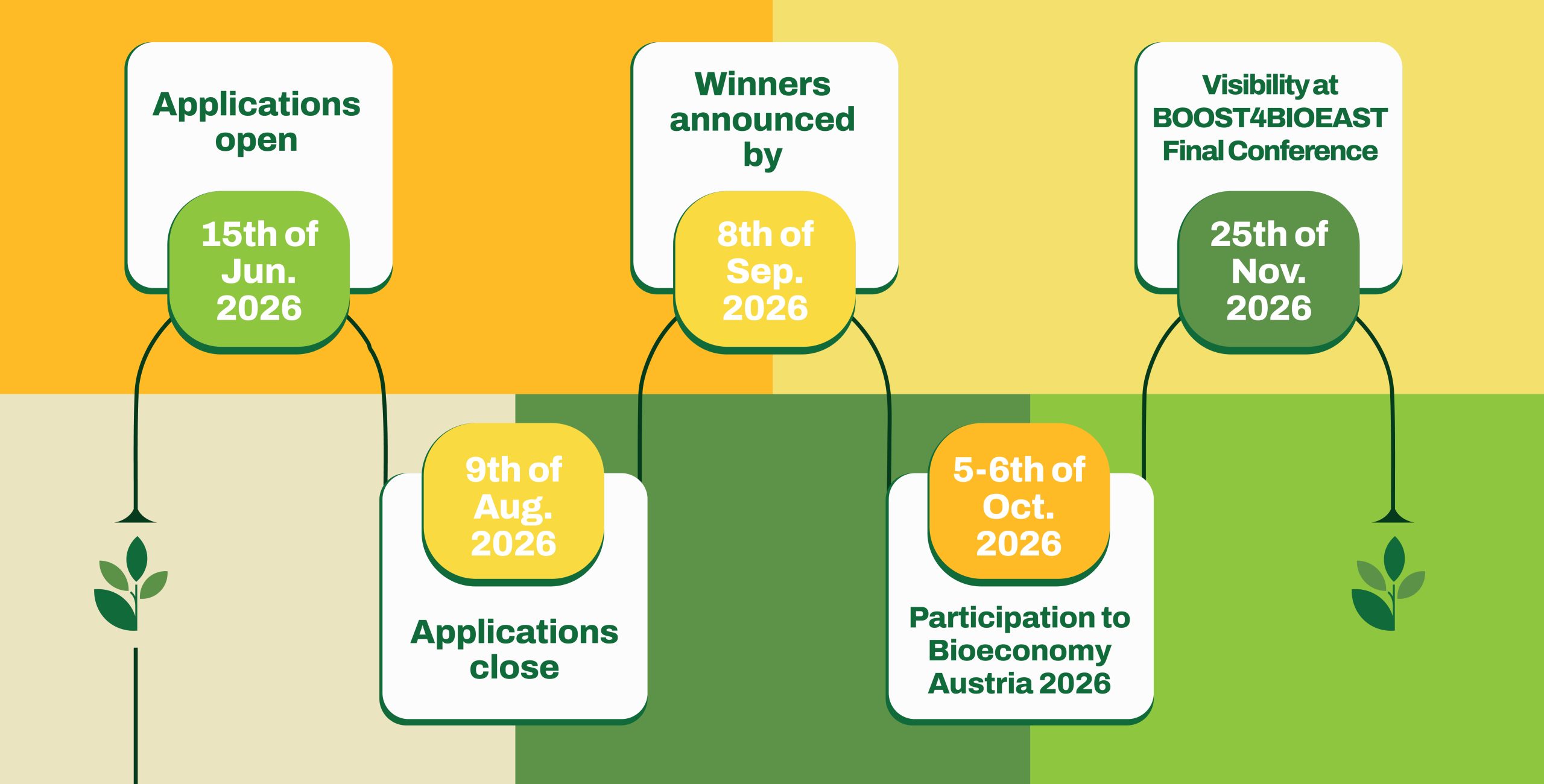
Submit your proposal by 9 August 2026 at 23:59 CEST.
Type of solutions we are looking for
We welcome student ideas and solutions at any stage, from a rough concept sketched in a notebook to a working prototype or research-backed proposal.
Solutions can be technological, organisational, social, or policy-oriented – as long as they address a challenge within one of the eight themes.
Who can apply?
Nationals and residents of Bulgaria, Croatia, Czech Republic, Estonia, Hungary, Latvia, Lithuania, Poland, Romania, Slovakia and Slovenia who are currently enrolled in – or have recently graduated from (within 12 months) – a higher education institution are welcome to apply. We accept applications from:
- Undergraduate students, individually or in teams
- Master’s students, individually or in teams
- PhD students and early-stage researchers, individually or in teams
- Student associations or clubs acting as a group
What will you get?
Successful applications will have the opportunity to:
- Visibility at the BOOST4BIOEAST Final Conference, a flagship event bringing together leading bioeconomy stakeholders from across the macro-region and beyond
- Engage with like-minded peers, researchers, and professionals across 11 countries
- Expand your professional network across Central and Eastern Europe
- Gain recognition from a pan-European bioeconomy community
Prizes
- Mentoring session focused on Innovation Readiness, supporting students in developing and refining their solution
- Pitching skills training to help you communicate your idea with clarity
- Invitation to Pitching session at the Bioeconomy Austria Summit organised by the Bioregions Facility
- Visibility at the BOOST4BIOEAST Final Conference in Brussels on 25 November 2026
Timeline
How to apply?
- Review the challenges description
- Read thoroughly the application guidelines for complete information about eligibility, application, and evaluation
- Submit your solution through this application form
Submit your proposal by 9 August 2026 at 23:59 CEST.