Five innovations, a shared regional ambition and one important question: how do we help good ideas move beyond the laboratory, the prototype and the project? At the BIOEAST Slovenia-Croatia Pitching Event 2026, innovators and experts explored what it takes to build a stronger circular bioeconomy.
By Mina Mansoor Rankel
What do a reusable partition wall, apple-processing residues, corn husks, a drone and a deck of cards have in common?
At the BIOEAST Slovenia-Croatia Pitching Event 2026: Bioeconomy in the Spotlight, they became five starting points for conversations about turning promising ideas into practical solutions. The event gave participants an opportunity to present their innovations, receive expert feedback and connect with potential partners.
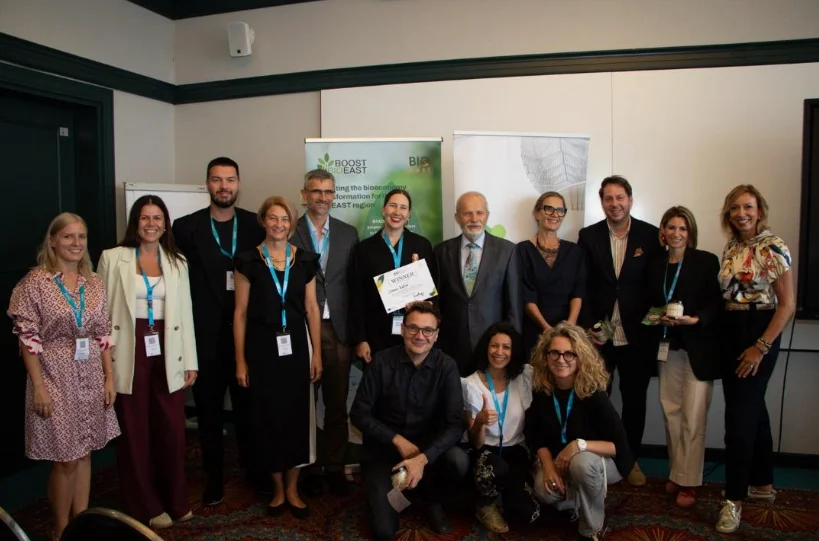
Slovenia-Croatia Pitching Event team. Photo: Samo Simonič, University of Maribor.
Held on 10 September at the Grand Hotel Bernardin in Portorož, the event was organised by Circular Change in cooperation with the Slovenian Bioeconomy Hub, Si.Bio, and BIOEAST HUB Croatia. It took place within the framework of the BIOEAST Initiative and Horizon Europe project BOOST4BIOEAST, in partnership with the 9th International Conference TBMCE 2026 – Technologies & Business Models for Circular Economy.
Five innovations, five different ways of creating value
The five pitches reflected the diversity of circular bioeconomy:
– KNOFmowa – Simona Kelher, Zavod KNOF: modular, reusable partition walls made from recovered materials.
– ReApple™ – Jana Šic Žlabur, University of Zagreb: turning apple pomace into a polyphenol-rich nutraceutical ingredient.
– VROCHE! – Vladan Srdić, Studio 360: a playful, card-based tool for engaging with sustainability and bioeconomy challenges.
– Corn Dolly – Darja Malešič: modular footwear combining corn husks, traditional weaving and circular design.
– HAWK EYE – Alen Hrustić, ALGO EKO: exploring drone imaging and data analysis to support monitoring of plant-protection-product use.
Together, these innovations show that building a circular bioeconomy takes more than scientific discoveries. It also calls for product development, entrepreneurship, design and market knowledge – and, crucially, collaboration across these fields.
Recognising the value already within our region
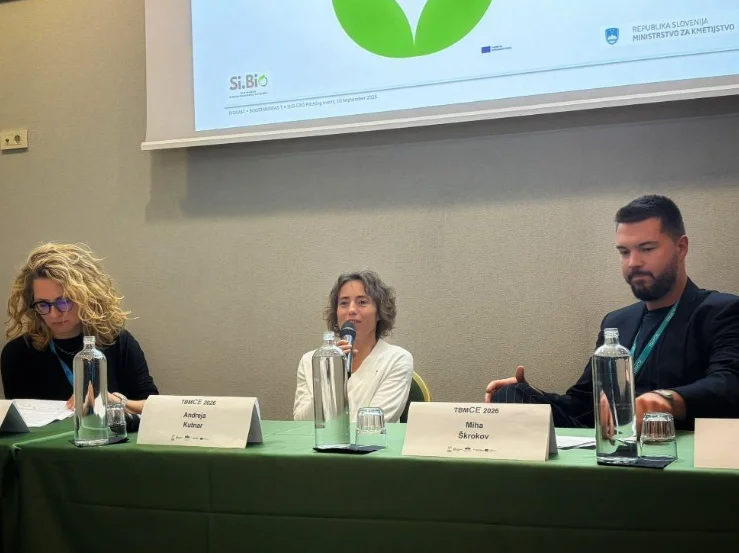
Prof. Dr. Andreja Kutnar of InnoRenew highlighted the wealth of natural resources, scientific knowledge, industrial capabilities and innovative solutions already present across Central and Eastern Europe. Her message was clear: we need to recognise these strengths more confidently, value what we create in our region and communicate our achievements more widely.
Building a stronger circular bioeconomy is therefore not only about creating something new, but also about recognising, connecting and building on the value already around us.
Investors invest in people, not only ideas
Tilen Šarlah, Country Manager Slovenia at Feelsgood Capital, brought an investor’s perspective: investors look not only at the innovation, but also at the people behind it – their motivation, ability to work together and capacity to navigate challenges.
A strong idea may open the door, but the team matters when deciding whether to invest.
Why good research should not remain “in the drawers”
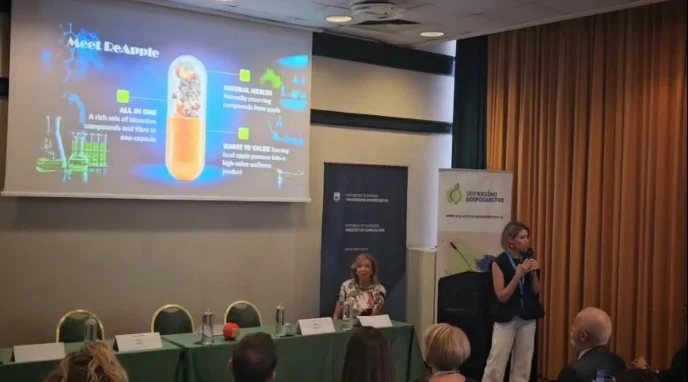
For Jana Šic Žlabur, the event highlighted a familiar challenge: promising research often lacks a clear path towards practical application. Researchers need better access to knowledge-transfer opportunities, business partners and funding.
Her central message was that valuable research should not remain “in the drawers” but find its way into real-world applications and create value for society and the economy.
Scientific excellence alone does not create market-ready solutions, nor should every researcher be expected to become an entrepreneur. What is needed are better pathways connecting research with the expertise, partners and resources needed to bring it into use.
From individual innovations to a shared regional ambition
The event also looked beyond individual innovations to the wider potential of the circular bioeconomy in Slovenia and Croatia.
State Secretary Velislav Žvipelj highlighted Slovenia’s strong biomass potential and the opportunity to create greater value from its biological resources and side streams. He also highlighted the preparation of Slovenia’s draft National Action Plan for the Circular Bioeconomy, developed through BOOST4BIOEAST, which focuses on turning existing strategies into practical implementation.
Si.Bio: connecting the people and capabilities behind the transition
Established through BOOST4BIOEAST together with other Slovenian partners involved in related European projects, Si.Bio brings together stakeholders across Slovenia’s bioeconomy to exchange knowledge, build connections and explore opportunities for cooperation.
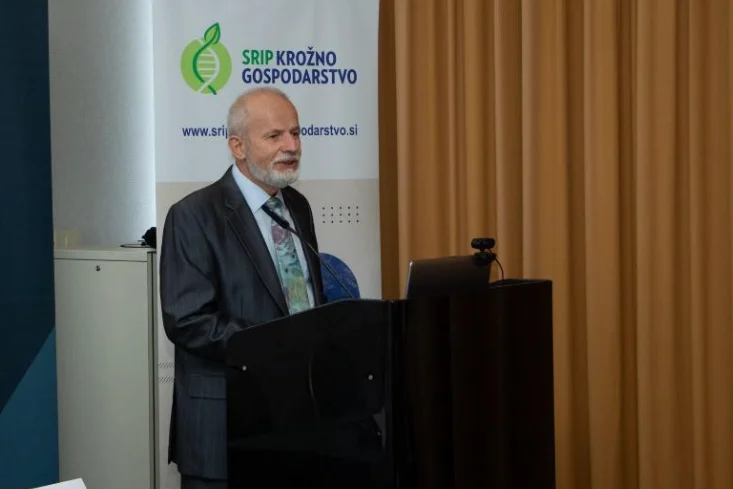
State Secretary Žvipelj welcomed its progress: “We are pleased to see that the hub is developing and gaining in importance, as today’s event demonstrates.”
By connecting different knowledge, capabilities and experience, Si.Bio can help turn new relationships into collaboration.
A winning solution, and a journey that continues
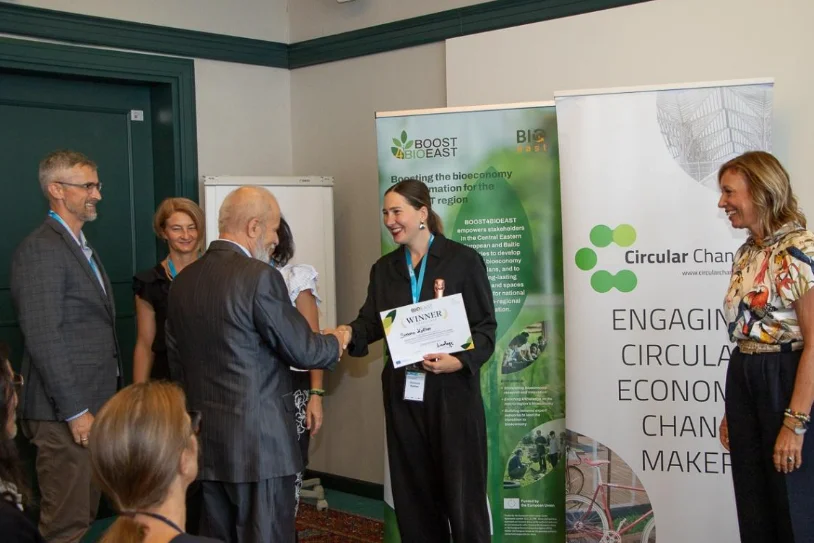
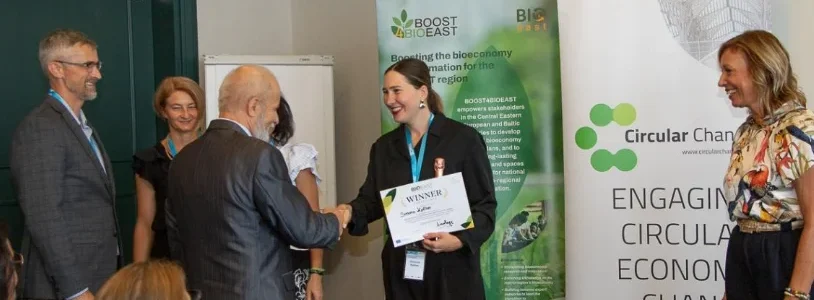
Winning in Portorož marked another milestone for KNOFmowa, following its earlier success in the BOOST4BIOEAST Open Innovation Challenge. As the winner, it will receive support towards participation in the Pitch Perfect Matchmaking & Networking Event 2026 in Brussels.
For Simona, the experience brought something particularly valuable: clarity. “A great idea is the crucial starting point, but it is simply not enough on its own. You have to know precisely where you are going and have a structured plan to get there.”
KNOFmowa’s next focus is on gaining new clients and exploring trade fairs as a market for its rentable, sustainable partition-wall solution.
What happens after the event
The connections made in Portorož will continue beyond the event. All five innovators will have opportunities for one-to-one mentoring with the jury and panel experts: Ana Belac, Managing Director at Impact Hub Ljubljana; Tilen Šarlah, Country Manager Slovenia at Feelsgood Capital; Assoc. Prof. Dr. Vanja Jurišić, University of Zagreb Faculty of Agriculture & Co-founder, Fibryion; Prof. Dr. Andreja Kutnar, University of Primorska & Scientific Councillor at InnoRenew CoE; and Miha Škrokov, Circular Bioeconomy Consultant at Anteja ECG, who also moderated the panel discussion.
We wish Simona and Zavod KNOF team, along with all the other innovators, every success and look forward to seeing where their ideas lead!