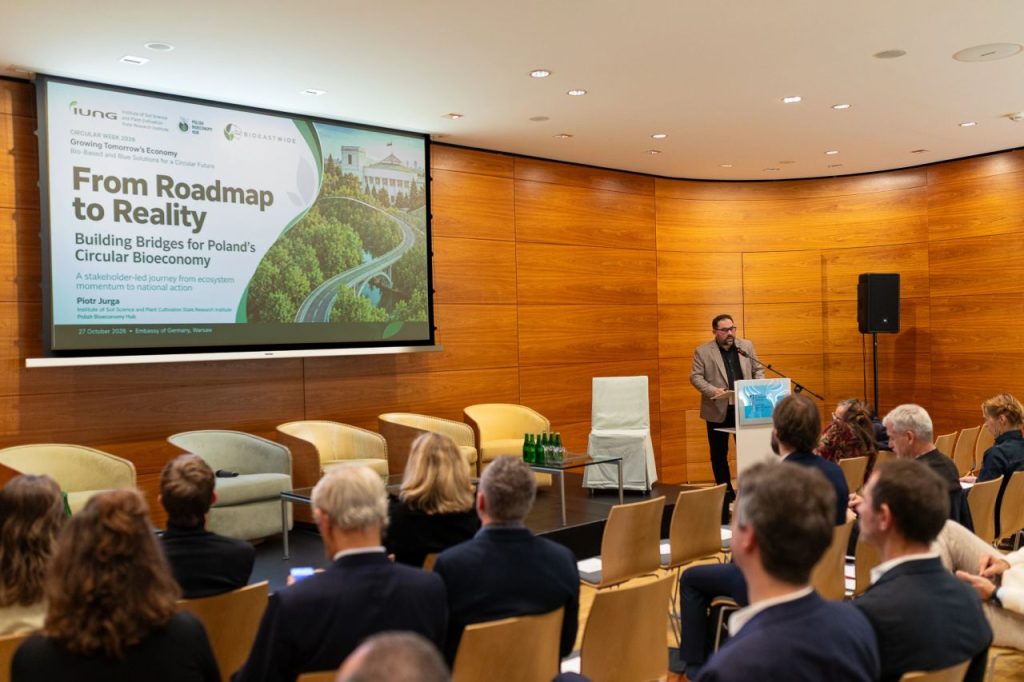
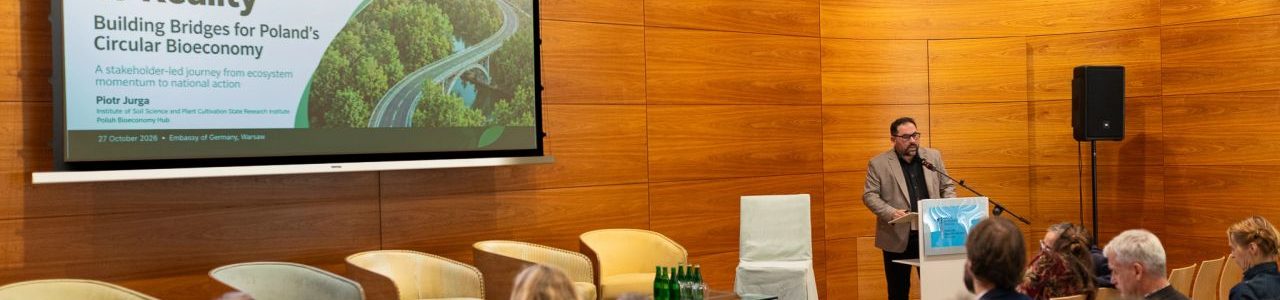
At Circular Week 2026, hosted at the German Embassy in Warsaw, Piotr Jurga (IUNG-PIB) presented the Roadmap for the Circular Bioeconomy in Poland. He called for a strategic decision that would allow Poland to become a macroregional leader in the circular bioeconomy.
Circular Week 2026 brought together representatives from policy, research, business and innovation at the German Embassy in Warsaw to discuss the future of the circular economy in Poland and in Europe. Piotr Jurga, Innovation Broker and Researcher at the Institute of Soil Science and Plant Cultivation – State Research Institute (IUNG-PIB), took part on behalf of the Polish bioeconomy community. He gave an opening presentation, joined a panel discussion and moderated a session on the blue bioeconomy.
A roadmap ready to become a strategy
Agata Kotkowska from the European Commission presented first. Piotr Jurga then gave an overview of what Poland has already achieved and what it could achieve next. Partners working within the Polish Bioeconomy Hub (Krajowy Hub Biogospodarki) have developed a Roadmap for the Circular Bioeconomy in Poland. With sufficient political commitment, this roadmap could form the basis of a national strategic document, followed by a comprehensive strategy and action plan.
He pointed to a recent example: Ireland launched its first National Bioeconomy Strategy during the Global Bioeconomy Summit in Dublin. This shows that such a step is achievable.
From panel debate to the blue bioeconomy
The panel discussion, moderated by Agnieszka Sznyk PhD, looked at these challenges from several angles. Speakers included Andrzej Stangret, Wilhelm Klümper, Adrianna Pawlik, Thomas Hartnik, Pawel Zylka and Sidse Jensen. A dedicated session on the blue bioeconomy then explored the potential of algae and other aquatic biological resources, how to scale up innovative solutions, and the importance of using these resources responsibly.
A message for the whole BIOEAST macroregion
The discussion in Warsaw reflects a challenge shared across Central and Eastern Europe. The region has great potential in the bioeconomy, but realising it requires strategic, coordinated action. National bioeconomy strategies, built on solid evidence and broad stakeholder engagement, remain one of the most effective tools to turn that potential into results.
The event was organised by the Institute for Innovation and Responsible Development (INNOWO), with the support of Ambassador Miguel Berger and the German Embassy in Warsaw.